
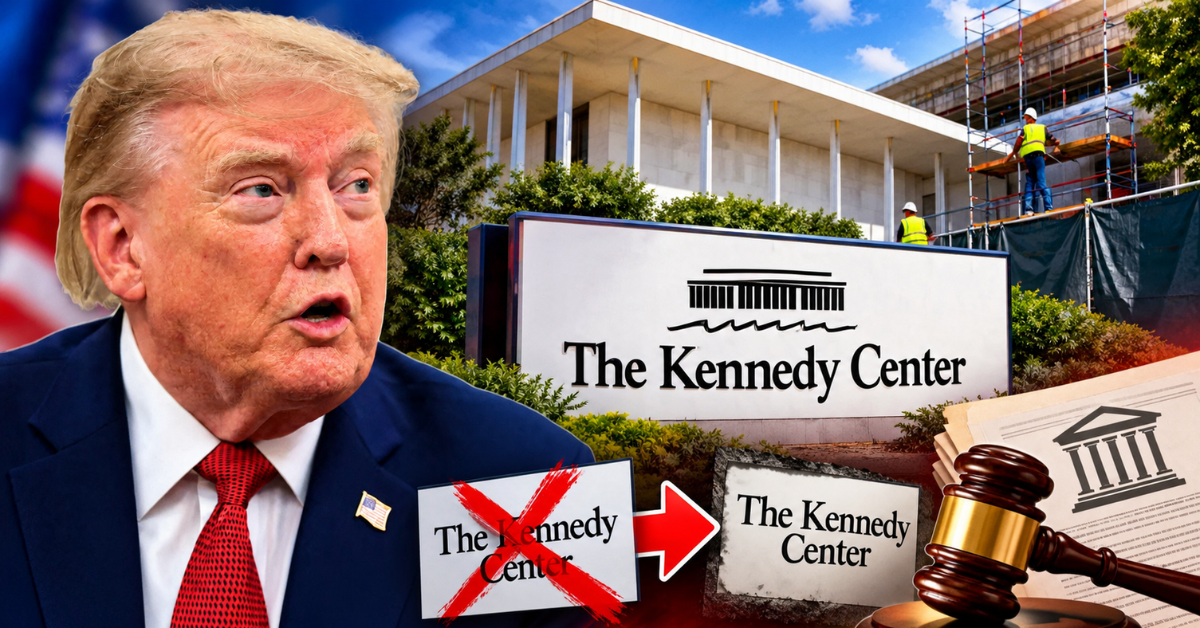
Explore the Trump administration’s Kennedy Center changes, the dispute over its name, renovation plans, court rulings and what happens next.
Suggested tags: Donald Trump, Kennedy Center, White House, Congress, U.S. courts, arts and culture
The Trump administration’s changes at the John F. Kennedy Center for the Performing Arts have triggered a legal and political dispute over the institution’s name, leadership, renovation plans and future. What began as an effort to reshape the management of the Washington, D.C., cultural institution developed into a court battle over whether its board could add President Donald Trump’s name to a memorial established by Congress.
The dispute also involves plans for major renovations and a proposed temporary closure. Supporters of the administration have emphasized improvements to the building, while critics have questioned the legality of the naming decisions and the process used to approve changes.
Here is what is known about the controversy, the relevant legal decisions and the questions that remain unresolved.
What Is the Kennedy Center?
The John F. Kennedy Center for the Performing Arts is a major performing arts institution in Washington, D.C. It serves as a national cultural center and memorial to President John F. Kennedy, who was assassinated in November 1963.
Congress established the institution’s statutory framework through federal legislation. The original law and subsequent amendments can be researched through the official “U.S. Code provisions governing the Kennedy Center”. Search for Title 20, Chapter 3A, Subchapter V, Part D, which contains the relevant statutory provisions.
The institution hosts performances, educational programs and other cultural events. Its role as a memorial is central to the legal dispute because the question is not simply whether a building can display a president’s name, but whether its governing board has the authority to change a name established by federal law.
How Did the Trump Administration Become Involved?
In February 2025, President Trump announced changes to the Kennedy Center’s board of trustees and took a leadership role at the institution. The appointments included administration allies and other individuals selected to serve on the board.
The historical record of the appointments is available in this “presidential appointments announcement” which reproduces the White House announcement dated February 13, 2025.
The administration subsequently pursued changes to the center’s leadership and direction. These changes became controversial as disputes developed over board governance, programming, renovations and the use of Trump’s name.
The board’s authority and the legality of its actions became central issues in litigation involving Representative Joyce Beatty, an Ohio Democrat and an ex officio member of the board.
Why Did the Kennedy Center Name Become a Legal Dispute?
In December 2025, the Kennedy Center’s board voted to add Trump’s name to the institution. The administration and center then began using the Trump-Kennedy Center name in signage and official materials.
Critics argued that the board could not unilaterally change the name of a memorial that Congress had designated for President Kennedy. Beatty challenged the move in federal court.
In May 2026, U.S. District Judge Christopher Cooper ruled that the board had exceeded its statutory authority by renaming the institution and ordered Trump’s name removed from the building and official materials. The ruling emphasized that Congress, rather than the board acting alone, had the authority to change the institution’s formal name.
The court’s written opinion and order are available in the “federal case record for Beatty v. Trump”
This was a judicial ruling, not merely a political objection. However, the administration continued to contest the consequences of the decision through subsequent legal proceedings.
Key Events in the Kennedy Center Dispute
| Date | Event | Why it matters |
| February 2025 | Trump announced new board appointments and took a leadership role. | The administration began reshaping the institution’s governance. |
| December 2025 | The board voted to add Trump’s name to the center. | The naming decision prompted a legal challenge. |
| May 2026 | A federal judge ruled against the board’s unilateral renaming | The ruling held that the board lacked authority to change the institution’s formal name in this way. |
| June 2026 | Trump’s name was removed from the building’s facade. | The center acted following the court’s order. |
| August 2026 | The board approved a new inscription honoring Trump and a proposal to name the grounds after him | The revised plan generated further legal objections |
| October 2026 | The dispute continued, including litigation concerning a proposed closure and renovation plans | The center’s future and the administration’s authority remained contested |
What Are the Renovation Plans?
The administration has argued that the Kennedy Center needs substantial work to address building conditions and modernize its facilities. In March 2026, Trump discussed an extensive renovation plan, including a proposed two-year closure of the main venue.
The board later approved a closure and renovation proposal in August. The plan raised questions about how performances would be handled during the work, how renovations would be financed and what authority the board had to make decisions affecting the institution.
The renovation debate should be separated from the naming dispute. A building may require repairs even when a separate decision about its name is challenged in court.
The administration has also argued that major work is necessary to preserve the facility. Those arguments are the administration’s stated position; they should not automatically be treated as independent proof of every claim about the building’s condition or the necessity of a particular closure timetable.
Readers can consult the “Kennedy Center’s official website” for institutional information, programming announcements and updates.
What Happened in the Latest Legal Dispute?
The legal conflict continued after the initial ruling. In August 2026, the board approved a new approach that included an inscription crediting Trump with restoration and renovation work, as well as a proposal to call the grounds President Donald J. Trump Plaza.
The administration argued that this approach was different from formally renaming the Kennedy Center. Opponents argued that the new plan could conflict with the court’s earlier order and the statutes governing the memorial.
In October 2026, another issue emerged in the litigation: Trump asserted executive privilege over certain presidential communications sought in connection with Beatty’s challenge to the proposed closure. According to reporting published October 15, the assertion concerned communications involving Trump, his advisers and Kennedy Center employees.
Executive privilege is a legal doctrine that can protect certain presidential communications. Its assertion does not, by itself, resolve the underlying lawsuit or establish that every requested document is protected.
The latest filings and orders should be consulted to determine how the court addresses the privilege claim and any further disputes over the renovation plan.
What Is Confirmed—and What Remains Disputed?
Several facts are established by public records: the administration changed the board’s composition, the board voted to add Trump’s name, and a federal judge ruled that the board could not unilaterally rename the memorial in the manner it had chosen.
Other issues require more careful wording. The administration’s claims about renovation needs, the legal significance of a proposed inscription and the consequences of closing the venue should be attributed to the relevant officials or filings unless independently established.
It is also important not to describe a new inscription as though a court had approved it simply because the board voted for it. A board resolution, an administration argument and a final judicial ruling are three different things.
Frequently Asked Questions
Can the Kennedy Center be renamed by its board?
A federal judge ruled in May 2026 that the board could not unilaterally rename the institution in honor of Trump under the governing statutory framework. The court’s opinion explains the legal reasoning. Any subsequent proposal must be assessed against the actual court orders and applicable law.
Why does the Kennedy Center honor John F. Kennedy?
Congress established the center as a national cultural institution and memorial to President Kennedy following his assassination in 1963. Its statutory status is a central reason the naming dispute became a federal court case.
Why does the Trump administration want renovations?
The administration has said that substantial work is needed to improve and preserve the building. The scope, timing, financing and consequences of the proposed closure remain important questions for public oversight.
Will the Kennedy Center close for two years?
A two-year closure has been proposed and approved by the board, but readers should consult current official announcements and court orders before treating the timetable as final. Legal proceedings may affect implementation.
Is the Kennedy Center lawsuit over?
The available October 2026 reporting indicates that legal disputes remained active, including issues concerning the proposed closure and executive privilege. The current docket should be checked for any later rulings.
Conclusion
The Kennedy Center dispute is about more than a name on a building. It raises questions about the authority of a federally established institution’s board, the role of Congress in protecting a national memorial, the scope of presidential influence and the future of a major performing arts venue.
The May 2026 ruling rejected the board’s unilateral renaming of the center, but later proposals and additional litigation kept the broader conflict alive. The renovation debate adds another layer: the public needs reliable information about the building’s condition, the proposed work, its costs and the effects on performances.
As the case develops, the clearest way to understand the dispute is to distinguish official records and court rulings from political statements and disputed claims. The outcome will depend on the governing law, the court’s orders and the decisions made by the institution and its oversight bodies.
Sources to consult before publication: “U.S. Code“, “federal court case record” “Kennedy Center official website“, and “presidential appointments announcement”

[…] READ MORE : Trump and the Kennedy Center: Renovations, Name Dispute and Lawsuit […]