
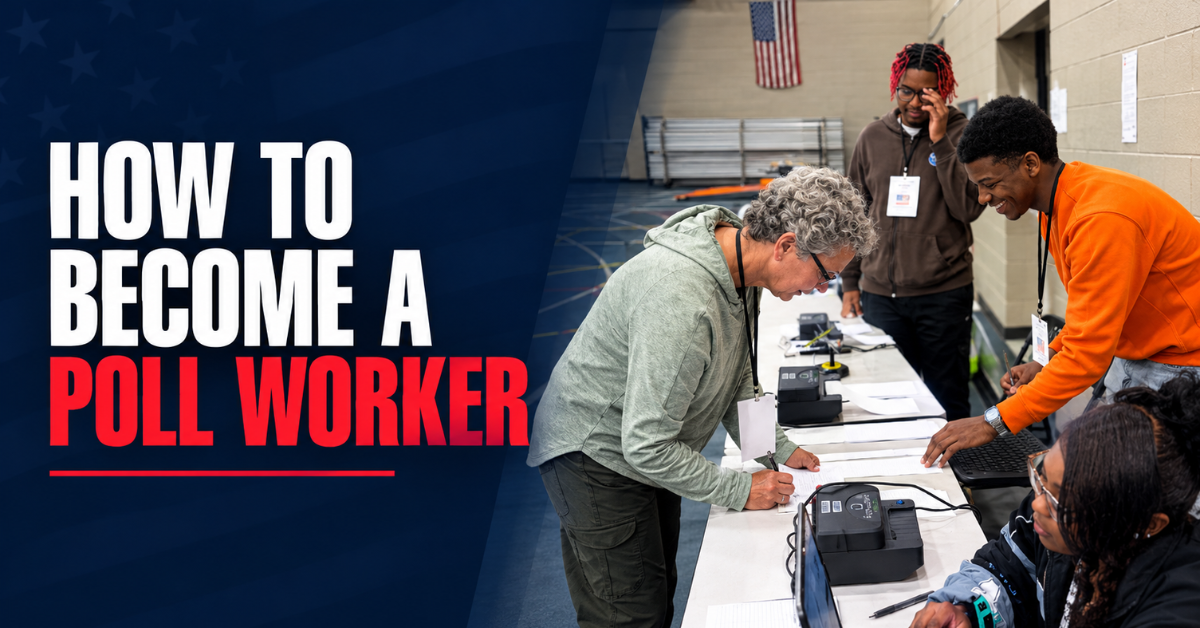
If you have ever wondered who helps run a polling place on Election Day, the answer often includes poll workers. These temporary election workers help check in voters, distribute ballots, explain voting procedures and make sure polling locations follow the rules established by election officials.
With the 2026 U.S. midterm election approaching, some Americans may be looking for ways to work at a polling place, earn extra money or contribute to their local community.
But how do you become a poll worker? Do you have to be registered to vote? How much do poll workers get paid, and can you still apply before Election Day?
The answers depend on where you live. Here is how to check your eligibility, find an official application and understand what the job involves.
What Is a Poll Worker?
A poll worker is someone who helps election officials operate a polling location during early voting or on Election Day. Depending on the jurisdiction, the position may also be called an election worker, election clerk, election judge, precinct official or polling-place worker.
Poll workers help elections run smoothly by assisting voters and carrying out assigned election procedures. They are not responsible for choosing winners or independently deciding how votes should be counted.
According to the “U.S. Election Assistance Commission (EAC)” poll workers may open polling locations, check in voters, issue ballots, assist voters, safeguard election materials and reconcile voting records when the polls close.
Most positions are temporary and are recruited by state or local election offices.
How to Become a Poll Worker in 2026
The most reliable way to become a poll worker is to apply through the election office responsible for your area. Follow these steps to find out whether you qualify and whether applications are still open.
Step 1: Find your local election office
Start with the official “EAC Poll Worker Recruitment Lookup Tool“.
The tool helps people locate information from their state or local election office, including eligibility requirements, training, hours, compensation and application details.
You can also contact your county election office, county clerk, municipal election office or local board of elections directly.
Make sure you use an official government website before submitting personal information.
Step 2: Check the eligibility requirements
Before applying, confirm that you meet the rules for the jurisdiction where you want to work.
Depending on the state and local election office, requirements may include:
- Being a registered voter.
- Meeting a minimum age requirement.
- Living in the required state, county, municipality or precinct.
- Meeting any applicable political party or party-balance rules.
- Completing mandatory training.
- Being legally eligible to perform the assigned duties.
Not every jurisdiction has identical requirements. Some also operate student poll-worker programs or make exceptions for particular positions.
The “National Conference of State Legislatures’ election poll-worker guide” provides a detailed overview of state-level laws and requirements.
Do not assume that being registered to vote in one state automatically qualifies you to work at a polling place in another. Check the rules for the specific jurisdiction.
Step 3: Complete the application
Once you find an official recruitment page, follow its instructions.
You may need to provide your name, contact information, address, age or voter-registration information. The exact application process varies.
Some election offices accept applications online. Others may ask applicants to contact an office, attend an orientation or complete additional paperwork.
If you are applying close to Election Day, check whether the office is still accepting applications for the particular election and position.
Step 4: Attend the required training
Many jurisdictions require poll workers to complete training before serving.
Training may cover voter check-in procedures, ballot handling, voting equipment, accessibility, election security, closing procedures and how to respond when an unusual situation arises.
The “EAC’s poll-worker resources” explain the importance of recruitment, training and preparation.
Ask the election office whether training is paid, whether attendance is mandatory and whether you must pass a test or complete specific preparation before your assignment.
Step 5: Confirm your assignment and schedule
After applying, wait for confirmation from the election office. Submitting an application does not necessarily mean you have been selected.
If accepted, confirm your reporting location, arrival time, assigned duties, dress requirements, meal arrangements and compensation.
Some assignments require workers to arrive before voting begins and remain until closing procedures are completed. Others may offer part-time or split shifts where local rules permit.
Can You Still Become a Poll Worker Before the November 2026 Election?
The next regularly scheduled U.S. federal general election is November 3, 2026.
As of October 28, the election is only days away. Some jurisdictions may have completed recruitment and training, while others may still need workers or maintain backup lists.
Your best option is to contact your local election office immediately and ask:
- Are you still accepting poll-worker applications for November 3, 2026?
- Are there vacancies or backup positions available?
- Is there time to complete the required training?
- What are the eligibility requirements and work hours?
- What compensation is offered for the position?
Do not rely on an old job listing or assume that an application deadline is still open.
If recruitment has closed for this election, ask whether you can register your interest for future elections. Local election offices may recruit for primaries, special elections and subsequent general elections.
For broader U.S. voting information, visit “USA.gov’s official voting guide“
How Much Do Poll Workers Get Paid?
Poll worker pay varies considerably by state, county, municipality, position and election.
Some jurisdictions set a minimum daily payment, others use hourly wages, and some determine compensation locally. Training may also be compensated separately. Certain volunteer programs do not offer pay.
The EAC’s “Election Worker Recruitment, Training, Retention, and Evaluation Report” documents these differences and explains why there is no single national pay rate.
The following table summarizes what you should check before accepting a position.
| Pay question | What to confirm |
| Daily or hourly pay | The official rate for your position |
| Training compensation | Whether required training is paid |
| Work hours | Full-day, half-day or split-shift options |
| Payment timing | When and how you will receive payment |
| Additional expenses | Whether meals, travel or other expenses are reimbursed |
For example, the “New York State Board of Elections’ poll-worker information page” explains eligibility, assignments, training and compensation for its jurisdiction.
Use your own state or county election office to verify the applicable rate. Do not assume that another state’s advertised pay applies where you live.
What Does a Poll Worker Do on Election Day?
Poll workers perform practical tasks that help election officials administer voting according to established procedures.
Before voting begins
Workers may help prepare the polling location, organize supplies, set up voting equipment and complete required opening checks.
While polls are open
Depending on the assignment, duties may include:
- Welcoming voters and directing them to the correct area.
- Checking registration records and following identification procedures.
- Issuing the appropriate ballots.
- Explaining voting procedures without influencing a voter’s choices.
- Helping voters access permitted accommodations.
- Following rules for handling ballots and election materials.
- Referring complex questions or problems to the designated supervisor.
After voting ends
Workers may help close the polling location, account for election materials, complete records, secure ballots and follow the jurisdiction’s procedures for transferring equipment or materials.
The work requires patience, attention to detail and a willingness to follow instructions. Poll workers must treat voters respectfully and apply the relevant procedures consistently.
Is Being a Poll Worker a Full-Day Job?
It can be, but the schedule depends on the jurisdiction and position.
Some poll workers must arrive early and remain until voting and closing procedures are complete. In other places, part-time assignments or split shifts may be available.
The NCSL’s “state-by-state poll-worker guide” describes how work schedules differ under state laws.
Before accepting an assignment, ask how long you are expected to work, whether breaks are provided, whether you must attend training on another day and whether the advertised compensation covers the entire assignment.
Can Students Become Poll Workers?
Some jurisdictions offer opportunities for high school students and other young people to assist with elections.
Eligibility depends on local law and the specific program. Some student programs allow eligible minors to serve under special rules, while other positions require workers to meet the standard minimum age or voter-registration requirements.
If you are a student, ask your state or county election office whether it offers a student poll-worker program, what age restrictions apply and whether parental permission or school approval is required.
Do not assume that the rules for adult poll workers apply to every student program.
Is Being a Poll Worker Worth It?
For people interested in civic participation, working at a polling place can be a practical way to learn how elections are administered.
Potential benefits include temporary paid work where compensation is offered, experience following formal procedures, contact with people in your community and a better understanding of the voting process.
There are also considerations. Election Day can involve long hours, repetitive tasks, busy periods and situations that require patience. Workers must follow election rules even when voters are frustrated or circumstances are stressful.
Whether the role is worthwhile depends on your schedule, local compensation, duties and interest in public service.
Frequently Asked Questions
How do I sign up to be a poll worker?
Visit the “EAC’s Help America Vote page” find your local election office, check eligibility and follow the official application instructions.
Do poll workers have to be registered voters?
Some jurisdictions require poll workers to be registered voters, while rules and exceptions vary. Check your state’s current requirements before applying.
How much do poll workers make per day?
There is no single nationwide rate. Pay depends on the jurisdiction, position and schedule. Check your local election office’s compensation information.
Do poll workers receive training?
Many jurisdictions require training before a worker can serve. The format, duration, compensation and completion requirements vary.
Can I become a poll worker if I have never done it before?
First-time applicants may qualify if they meet the applicable requirements and complete any required training. Previous election experience is not a universal requirement.
Can I work as a poll worker for only half a day?
Some jurisdictions offer part-time assignments or split shifts, while others require longer shifts. Ask the local election office about the options available.
Is a poll worker the same as a political campaign worker?
No. A poll worker helps administer voting under election procedures. A campaign worker supports a candidate or political campaign. These are different roles with different responsibilities.
What if applications for the 2026 election are closed?
Ask your local election office about backup opportunities, remaining vacancies or recruitment for future elections. Do not assume a closed application means you cannot apply for a later election.
Final Thoughts
Becoming a poll worker is one way to participate directly in the administration of American elections. The process generally involves finding your local election office, checking eligibility, submitting an application and completing any required training.
With November 3, 2026, approaching, availability will depend on where you live and whether your local office still needs workers. Verify deadlines and compensation through official sources before making plans.
For more election explainers, visit “PoliticalTweet.com” You can also read our guide to “how many senators there are in the United States” to understand the congressional system affected by federal elections.

hi